Solid aluminum panels, ACP/ACM, and aluminum honeycomb panels can all create a clean metal facade, but they are not interchangeable materials. Their internal structures are fundamentally different, which changes weight, stiffness, forming capability, panel size, fire-review requirements, fabrication methods, installation details and project cost.
For architects, facade contractors and procurement teams, the better question is not “Which aluminum panel is best?” but which panel construction best matches the specific facade condition. This guide compares solid aluminum panel vs ACP vs aluminum honeycomb panel and explains where each material has an advantage.
Choose Solid Aluminum Panel when complex shapes, bending, welding, perforation, durable exterior finishes and design flexibility are priorities.
Consider ACP / ACM when economical flat cladding and efficient standard panel fabrication are priorities—but always confirm the core type, certification and complete wall fire requirements.
Choose Aluminum Honeycomb Panel when large-format flat panels, high stiffness-to-weight performance and dimensional stability are especially important.
From several meters away, the three facade materials may look similar. In section, however, they are completely different products.
A solid aluminum panel is fabricated from a single aluminum sheet. Depending on design, it can be cut, folded, curved, welded, perforated and reinforced with stiffeners.
ACP or ACM normally consists of thin aluminum skins bonded to a core. Core composition varies significantly between products and is especially important when reviewing fire performance.
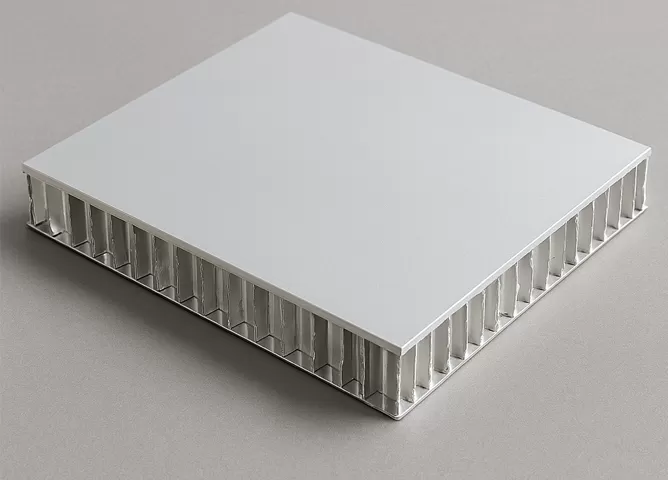
Aluminum honeycomb panels use aluminum face sheets bonded to a cellular honeycomb core, creating a sandwich structure with high stiffness relative to weight.
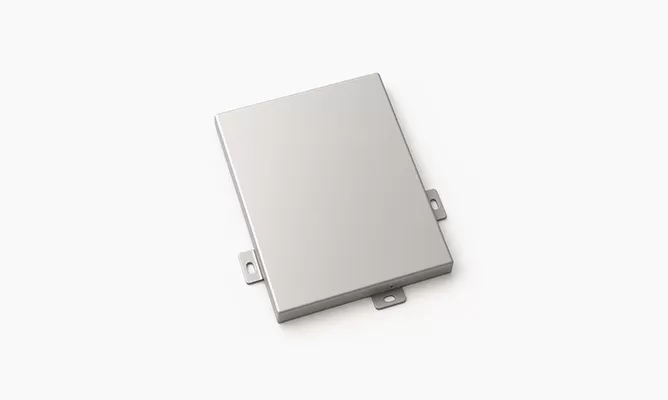
Architectural solid aluminum panel is made from one continuous aluminum sheet rather than a laminated core construction. The sheet can be CNC cut and formed into flat cassettes, folded returns, curved surfaces, column covers, soffits and irregular facade elements.
ALTOP's current aluminum solid panel range includes common 2.0, 2.5 and 3.0 mm options, with project-specific thicknesses and custom fabrication available according to the product specification.
Its biggest advantage is not simply “strength.” It is the ability to combine material continuity with extensive fabrication freedom.
ACP means aluminum composite panel, while ACM refers more broadly to aluminum composite material. A typical panel contains two relatively thin aluminum face sheets bonded to an internal core.
This sandwich structure allows ACP to remain relatively light and flat while using less solid aluminum than an equivalent monolithic sheet. It is therefore widely used for flat architectural cladding, commercial facades, signage and interior applications.
Important: The term “ACP” alone does not describe fire performance. Core composition, panel certification, fixing system, insulation, cavity and the complete exterior wall assembly all need to be reviewed.
An aluminum honeycomb panel is a sandwich panel made from aluminum skins bonded to a hexagonal aluminum honeycomb core.
Instead of relying on a thick solid sheet for stiffness, the distance between the two skins and the cellular core create a deeper structural panel. This makes honeycomb construction particularly useful when panel flatness, larger dimensions and stiffness-to-weight performance matter.
ALTOP's current reference range includes panel thicknesses from 6–30 mm and project-specific large-format dimensions.
| Comparison | Solid Aluminum | ACP / ACM | Aluminum Honeycomb |
|---|---|---|---|
| Construction | Single aluminum sheet | Thin aluminum skins + composite core | Aluminum skins + cellular aluminum core |
| Weight | Moderate; depends strongly on sheet thickness | Generally lightweight | Lightweight relative to panel depth and stiffness |
| Large-Panel Stiffness | Depends on thickness, folded returns and stiffeners | Suitable for many standard flat panels | Strong advantage where high stiffness-to-weight ratio is required |
| Complex Forming | Excellent potential for bending, welding, curving and custom shapes | Good for standard routing and folding; limitations depend on product construction | Best suited to relatively flat or engineered panel geometries |
| Perforation / Decorative Cutting | Very suitable | Product-dependent | Less straightforward because of sandwich construction |
| Fire Review | Metal sheet has no combustible composite core; complete wall assembly still requires project review | Core composition is a critical variable | Core and bonding construction must be reviewed as part of the specified panel and wall system |
| Repair / Modification | Fabrication may be modified depending on finish and design | Usually replaced as a composite panel unit | Usually treated as a bonded sandwich panel unit |
| Initial Material Cost | Project-dependent | Often selected for cost-efficient flat cladding | Typically justified where stiffness or large-format performance adds value |
| Typical Strength | Shape and fabrication flexibility | Efficient flat cladding construction | High panel stiffness at relatively low weight |
If the facade contains deep returns, curved corners, folded soffits, three-dimensional forms or decorative perforation, solid aluminum often provides the most direct fabrication route.
Solid aluminum: can be CNC cut, bent, rolled, welded and reinforced, making it well suited to customized architectural shapes.
ACP: can be routed and folded efficiently into cassette forms but its composite construction creates different edge-detail and forming limitations.
Honeycomb: performs best when designers make use of its sandwich-panel stiffness rather than forcing it into highly complex small-radius geometry.
Panel stiffness is strongly influenced by section depth. A honeycomb sandwich panel separates two thin aluminum skins with a relatively deep cellular core, allowing the complete panel to resist bending more efficiently than the individual skins could alone.
This is especially useful when an architect wants a large, visually flat panel without simply increasing the thickness of a solid sheet.
However, maximum panel size should still consider wind load, fixing spacing, edge construction, fabrication, transport, lifting and installation—not only the manufacturer's nominal sheet dimensions.

This is one area where oversimplified comparison tables can be dangerous. The correct answer depends on both the panel construction and the complete exterior wall assembly.
Solid aluminum: does not contain the type of internal polymer or mineral composite core found in ACP, but coatings, insulation, membranes and other wall components still form part of the complete facade fire design.
ACP / ACM: fire behavior depends heavily on the core formulation. Products should therefore be identified by their tested construction and certification rather than described simply as “ACP.”
Aluminum honeycomb: also needs to be evaluated as a complete bonded panel and wall assembly, including adhesives, coatings, insulation and fixing system.
ASTM E84 measures comparative surface flame spread and smoke development under its specified test conditions. ASTM explicitly cautions that an E84 flame-spread result by itself does not define a material as noncombustible.
For exterior walls where NFPA 285 is applicable, the wall should be considered as a complete system—including the base wall, insulation, WRB, air gap, mounting system and exterior cladding.
Exterior metal facade appearance depends on more than the substrate. Coating system, gloss level, metallic effect, color consistency, batch control, panel orientation and fabrication all influence the finished elevation.
Solid aluminum and honeycomb aluminum panels can both use architectural finishes such as PVDF-type coatings, powder coating and anodized finishes depending on the product specification. For a large project, coating requirements should be defined before suppliers are compared.
ACP is often selected for cost-efficient flat cladding, but a panel's purchase price is only one part of facade cost.
Material utilization, supporting frame, panel size, stiffeners, fabrication complexity, edge treatment, fire specification, coating, fixing method, installation labor, replacement strategy and quantity can all change the final installed cost. A large honeycomb panel may cost more per panel but potentially solve a stiffness or flatness problem that would otherwise require a different support strategy.
Especially when welding, curved panels, folded returns or irregular shapes are required.
Cutting, perforating, folding and reinforcing can be integrated into the fabrication process.
Its sandwich construction can provide high stiffness and flatness without relying on a very thick solid sheet.
ACP may be attractive commercially, while solid aluminum and honeycomb may offer different advantages depending on specification and panel size.
Review the specified panel construction, fire-test documentation, insulation, cavity, barriers and complete wall assembly against applicable code requirements.
Statements such as “Panel A is lighter than Panel B” can be misleading when the panels have different thicknesses, sizes and structural duties.
The more useful question is whether the selected panel achieves the required flatness and resistance to service loads with an efficient combination of panel depth, skin thickness, stiffeners and support spacing. This is one reason honeycomb panels can be attractive for large panels while solid aluminum remains attractive where local forming and fabrication flexibility matter more.
Aluminum itself has a well-established recycling value. The Aluminum Association highlights aluminum's high strength-to-weight ratio, durability, corrosion resistance and recyclability in building applications.
However, recyclability of the finished panel should consider its actual construction. A monolithic solid sheet, an ACP containing bonded dissimilar layers and an aluminum honeycomb sandwich panel can require different separation and recycling processes. For sustainability-focused projects, ask suppliers for material composition, recycled-content data and relevant EPD information rather than assuming all “aluminum panels” have identical lifecycle impacts.
Giving a manufacturer only panel dimensions and color is rarely enough for a meaningful comparison.
✓ Exterior or interior application
✓ Typical and maximum panel dimensions
✓ Flat, curved, perforated or three-dimensional geometry
✓ Required design wind pressure
✓ Support spacing and fixing concept
✓ Required coating or surface finish
✓ Fire-performance requirements and applicable code
✓ Target visual flatness and joint width
✓ Quantity and module repetition
✓ Project location, transport and installation constraints
ALTOP's current architectural aluminum range includes solid aluminum panels, honeycomb aluminum panels, perforated panels, aluminum cladding, screen panels and other customized metal facade components.
Start with ALTOP solid aluminum panel for folded, curved and customized architectural forms.
View Solid Aluminum Panel →Evaluate ALTOP honeycomb aluminum panel where sandwich-panel stiffness and large flat surfaces are priorities.
View Honeycomb Aluminum Panel →Review ALTOP's broader range of architectural aluminum panel and cladding options.
Explore Aluminum Panels →The next decision is panel thickness, dimensions, coating and fabrication. Our separate selection guide focuses specifically on those solid-aluminum specification questions.
Read: How to Choose Aluminum Solid Panel →Solid aluminum is made from one continuous metal sheet, while ACP uses thin aluminum skins bonded to a core. This difference affects fabrication, forming, fire review, weight and cost.
Not universally. Solid aluminum is especially attractive for complex forming, durable custom fabrication and projects where a monolithic metal panel is preferred. ACP can remain appropriate where its tested construction, core, finish and wall system meet project requirements.
“Stronger” is too broad. Honeycomb panels can provide high bending stiffness relative to their weight and thickness, while solid aluminum offers different advantages in local strength, forming and fabrication. Final performance depends on actual panel dimensions and support conditions.
Honeycomb construction is often worth evaluating for large flat panels because its sandwich structure provides high stiffness-to-weight efficiency. Solid aluminum can also be used for large panels with suitable thickness, returns, stiffeners and support design.
ACP should not be described generically as either fireproof or combustible without identifying its core and test documentation. Different products use different core constructions, and exterior-wall compliance may depend on the complete tested wall assembly.
Solid aluminum generally offers extensive customization because it can be cut, bent, rolled, welded, perforated and reinforced. The feasibility of each shape still depends on alloy, thickness, panel size and fabrication details.
Provide elevations, panel dimensions, geometry, design loads, fixing concept, finish, fire requirements, project location, quantity and any architectural or structural performance requirements. This allows the panel construction to be compared against the real project rather than by material name alone.
Panel selection should start with facade dimensions, geometry, support conditions, appearance and performance requirements. ALTOP can review architectural drawings and project specifications to help coordinate a suitable solid aluminum or honeycomb panel solution.
Send Your Panel Drawings for Review →