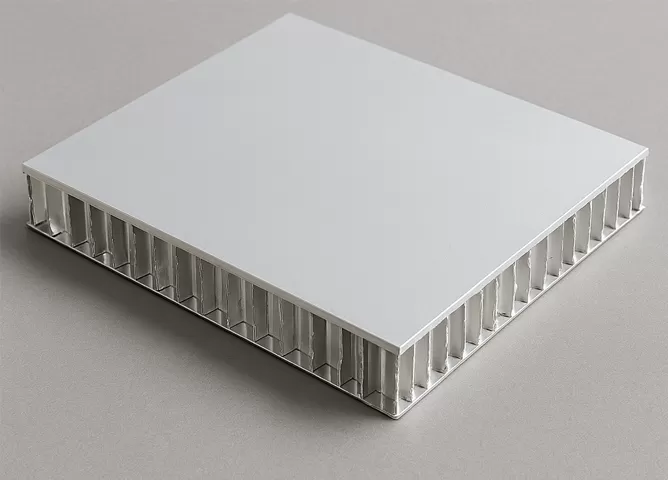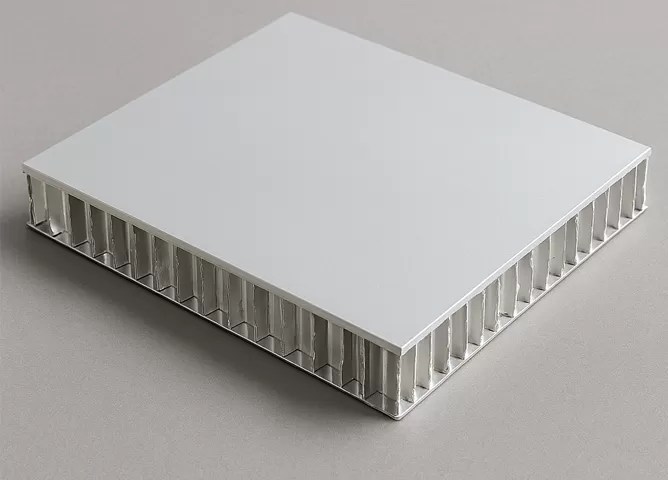
As an experienced aluminum honeycomb panel manufacturer, ALTOP supplies custom honeycomb panels for architectural facades, ceilings, partitions and other interior and exterior applications. Unlike solid aluminum panels made from a single sheet, an aluminum honeycomb panel uses aluminum face sheets bonded to a hexagonal aluminum honeycomb core, forming a lightweight sandwich structure with high stiffness relative to its weight.
This construction makes aluminum honeycomb panels particularly suitable for large, flat architectural surfaces where dimensional stability and panel flatness are important. ALTOP's current reference range includes overall panel thicknesses of 6–30 mm and aluminum skins of 0.5–1.5 mm, with panel size, skin thickness, core configuration, edge treatment, finish and fixing details selected according to project drawings and performance requirements.
An aluminum honeycomb panel is a bonded sandwich panel rather than a single metal sheet. Panel depth, aluminum skin thickness, honeycomb core, bonding quality, edge treatment and fixing details should therefore be considered together when selecting a panel for an architectural project.
| Item | ALTOP Reference | Project Consideration |
|---|---|---|
| Panel Construction | Aluminum skins + hexagonal aluminum honeycomb core | The complete sandwich construction, bonding system and edge details determine how the panel behaves as one unit. |
| Overall Panel Thickness | 6–30 mm | Overall depth should be selected according to panel dimensions, required stiffness, support spacing and project loads. |
| Aluminum Skin Thickness | 0.5–1.5 mm | Skin thickness affects local dent resistance, surface quality, edge treatment and fabrication requirements. |
| Core Material | Hexagonal aluminum honeycomb core | Core configuration forms the lightweight internal structure that separates the two aluminum skins. |
| Panel Size | Up to 1500 × 6000 mm reference size | Practical dimensions still depend on wind pressure, fixing layout, fabrication, transport, lifting and installation access. |
| Reference Weight | Approx. 3.5–7.5 kg/m² depending on construction | Weight varies with overall thickness, aluminum skin thickness and actual panel construction. |
| Surface Finish | PVDF / powder coating / anodizing / decorative imitation finishes | Finish should be selected according to exterior exposure, architectural appearance and project specification. |
| Typical Applications | Facades / ceilings / soffits / partitions / large interior wall panels | Honeycomb is particularly relevant when large panel dimensions, low weight and visual flatness are priorities. |
Engineering note: Overall panel thickness alone does not determine performance. Aluminum skin thickness, honeycomb core, bonding quality, edge construction, fixing positions and support spacing should be reviewed together for each project.
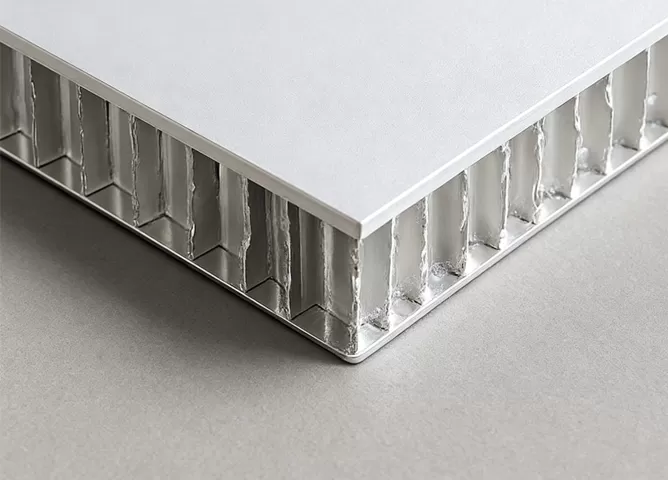
The performance of a honeycomb panel comes from the complete sandwich structure. Two aluminum skins are separated by a lightweight cellular core and bonded together so that the layers behave as one deeper panel.
Provides the visible architectural surface and receives the selected coating or anodized finish.
Transfers forces between the aluminum skin and honeycomb core so the sandwich panel can act as an integrated unit.
The cellular core keeps the two aluminum skins separated, increasing the depth of the panel without filling the entire section with solid metal.
Maintains continuous contact between the rear skin and the cellular core.
Works together with the face sheet and core to complete the sandwich construction.
Cut honeycomb edges expose the cellular core, so edge closure needs to be coordinated with panel joints, fixing points, handling and moisture protection.
Hangers, brackets, profiles or project-specific fixing details connect the bonded panel to the supporting subframe.
A honeycomb panel does not achieve stiffness simply by using more aluminum. Its advantage comes from separating two relatively thin aluminum skins with a lightweight core, creating a deeper structural section.
The honeycomb core maintains distance between the front and back aluminum sheets.
A deeper sandwich section can resist bending more efficiently than two skins placed directly together.
The panel can achieve useful stiffness and dimensional stability without relying on one very thick solid aluminum sheet.
This is why aluminum honeycomb panels are particularly worth evaluating for large-format flat facade and interior panels where weight and surface stability need to be considered together.
ALTOP's current reference range covers 6–30 mm overall panel thickness. The correct depth should not be chosen by the rule that “thicker is always better”; it should match panel dimensions and structural requirements.
May be considered where panel dimensions, loads and support spacing do not require a deeper sandwich section. Actual suitability should be verified for the project.
Often provides a practical balance where additional sandwich stiffness is useful without unnecessarily increasing panel depth.
A deeper honeycomb sandwich may be useful where larger panel dimensions and tighter deflection or flatness requirements justify greater section depth.
Do not select by total thickness alone. Aluminum skin thickness, core construction, panel width and length, support spacing, edge fixing and wind pressure all affect the final panel design.
The honeycomb core provides panel depth, but the aluminum skins remain critical to surface quality, local strength and load transfer. ALTOP's current reference skin range is 0.5–1.5 mm.
Skin thickness influences how sensitive the panel surface is to localized handling, impact or concentrated pressure.
Large smooth panels make surface consistency more visually important, especially under strong daylight and reflective finishes.
Local panel details around edges, inserts, hangers and brackets should consider the skin and core together.
Cutting, routing, edge closing and fitting installation can place different demands on the aluminum skin depending on the panel design.
Honeycomb construction can provide an important flatness advantage for large architectural panels, but a cellular core alone does not guarantee a visually perfect surface. Manufacturing and installation quality still matter.
The aluminum face sheets influence local surface stability and resistance to visible dents or imperfections.
A consistent core helps maintain even spacing between the two skins across the panel area.
Continuous bonding between skins and core is important so that the sandwich construction behaves consistently across the panel.
The depth of the sandwich section contributes directly to overall panel stiffness.
Poorly coordinated perimeter details can reduce local stiffness or introduce visible edge distortion.
Even a flat factory-made panel can appear distorted when installed onto an uneven subframe or over-constrained fixing system.
The exposed edge of a cut honeycomb panel is fundamentally different from the edge of a solid aluminum sheet. The cellular core must be coordinated with perimeter profiles, inserts, fixing points or other project-specific closure details.
Open cellular edges should be considered in relation to moisture, sealants, handling and adjacent construction.
Edge reinforcement can provide a more suitable local condition around panel perimeters and connection points.
Brackets, inserts and hangers need a properly engineered load-transfer zone rather than relying only on an exposed core.
Edge treatment affects visible joint lines, perimeter alignment and how the panel meets surrounding facade systems.
Edge closure and fixing methods should follow ALTOP's approved project details rather than assuming one standard edge construction is suitable for every panel.
Honeycomb is not automatically the best aluminum panel for every facade. Its advantages become most useful where panel size, flatness and stiffness-to-weight performance matter more than extensive welding or complex forming.
Large uninterrupted facade modules are one of the strongest reasons to evaluate honeycomb construction.
Lightweight sandwich construction can help where large overhead panel dimensions and visual continuity are priorities.
Honeycomb panels can create large smooth interior surfaces without requiring one very thick solid metal sheet.
The sandwich structure is useful where designers want panel depth and stiffness while limiting unnecessary metal weight.
Projects with long sight lines and smooth reflective finishes may benefit from the dimensional stability of a properly fabricated sandwich panel.
Repetitive large modules can benefit from factory-controlled panel construction, labeling and coordinated installation details.
Surface finish should be selected according to project exposure and architectural intent. The finish name alone does not define the complete specification.
| Finish | Typical Design Reason | Key Consideration |
|---|---|---|
| PVDF Coating | Demanding exterior facade applications and broad architectural color selection | Pretreatment, coating specification, color, gloss and project exposure |
| Powder Coating | Broad color and texture possibilities for interior or exterior architectural applications | Powder chemistry and performance classification should match the exposure environment |
| Anodizing | Natural metallic aluminum appearance | Alloy, substrate quality, batch control and panel orientation can affect appearance |
| Decorative Imitation Finish | Wood, stone or other architectural visual effects | Pattern consistency, orientation, durability and approved project sample |
For a more detailed finish comparison, read PVDF vs Powder Coating vs Anodizing →
These three materials can produce similar visual results after installation, but their internal structures make them suitable for different facade conditions.
| Comparison | Aluminum Honeycomb | Solid Aluminum | ACP / ACM |
|---|---|---|---|
| Construction | Aluminum skins + cellular aluminum core | Single aluminum sheet | Aluminum skins + composite core |
| Large-Panel Stiffness | Strong advantage due to sandwich depth | Depends on sheet thickness, folds and stiffeners | Suitable for many standard flat cladding applications |
| Stiffness-to-Weight | Major design advantage | Depends strongly on metal thickness and reinforcement | Generally lightweight |
| Complex Folding / Welding | More limited by sandwich construction | Strong advantage | Depends on product and routing system |
| Large Flat Surfaces | Particularly suitable | Requires careful reinforcement and support design | Suitable depending on panel system and project requirements |
| Best Starting Point | Large, flat, lightweight architectural panels | Curved, folded, welded or perforated custom forms | Standard economical flat cladding applications |
Read the full material comparison: Solid Aluminum Panel vs ACP vs Honeycomb Panel →
Honeycomb panel production requires coordination between dimensions, skins, core construction, bonding, edge treatment, finish and fixing details before manufacturing begins.
Confirm panel dimensions, joints, support zones and visible requirements.
Select overall depth, skin thickness and honeycomb construction.
Bonding & Assembly Bond aluminum skins and honeycomb core into the specified sandwich panel.
Coordinate edge closure, inserts, brackets or other project fixing details.
Check approved appearance, dimensions and visible panel quality.
Protect large finished panels for transport and project delivery.
Explore ALTOP's broader architectural aluminum panel range →
The following information helps evaluate panel depth, skin thickness, edge treatment, finish and fixing requirements more accurately.
An aluminum honeycomb panel is a bonded sandwich panel made from aluminum face sheets and a hexagonal aluminum honeycomb core. The cellular core separates the skins and creates a deeper lightweight section with high stiffness relative to weight.
The sandwich construction provides panel depth without using a fully solid section. This can improve stiffness-to-weight efficiency and dimensional stability, which is particularly useful for large flat architectural panels.
No. Overall panel depth should be selected together with aluminum skin thickness, panel dimensions, support spacing, wind pressure, edge details and fixing layout. Increasing thickness unnecessarily may add depth and cost without solving the actual design requirement.
Solid aluminum is made from one continuous sheet and is particularly suitable for folding, welding, curving and complex fabrication. Honeycomb panel is a bonded sandwich construction and is especially useful where large flat panel stiffness and low weight are priorities.
Face-sheet thickness, honeycomb core uniformity, bonding quality, overall panel depth, edge construction, panel dimensions, support-frame tolerance and installation conditions can all influence the final appearance.
Cutting a honeycomb panel exposes the cellular core. Edge closure may therefore be required to protect the core, provide local stiffness, support fixing components and create a clean joint with surrounding construction.
Fire performance should be verified for the actual bonded panel construction and complete wall or ceiling assembly. Aluminum skins, honeycomb core, adhesive or bonding system, coatings, insulation, cavities and applicable project test requirements may all need to be considered.
Provide architectural drawings, panel dimensions, preferred total thickness and skin thickness if specified, finish requirements, edge and fixing details, quantity, application, project location, delivery destination and available performance requirements.
Send ALTOP your panel layout, dimensions, facade or ceiling drawings, finish requirements, preferred panel construction, fixing details and project location. Our team can review the available information and discuss a project-specific aluminum honeycomb panel solution.
Discuss Your Honeycomb Panel Project →